Tag: Supergirl in the Multiverse

  • Supergirl in the Multiverse: Earth-496, Captain Kar-El of Krypton

    The Amalgam Universe was born from the cross dimensional being known as Access during the pages of Marvel vs. DC back in 1996. This birthed a total of 24 one-shot comics spread across 2 waves that showed stories of characters that were amalgamations of characters from the DC and Marvel universes. The Amalgam universe has several numeric designations such as 1996, 962, 9602, and 496 as well as just being referred to as the Amalgamverse. My coverage of this universe will feature 5 entries for Supergirl in the Multiverse and my initial plan was to use some of these alternative number designations for each. However, to make categorizing them easier I will just be using what seems to be the most likely DC designation of 496.

    As mentioned above, the Amalgam universe would take a character from the DC universe and one from the Marvel (sometimes more than 2 characters would merge). There are 2 canonical Amalgam characters that fit the Supergirl role, but I am also going to be putting together 3 of my own amalgamated Supergirls. This week’s entry is not a canonical Amalgam character, but it is a fairly obvious amalgamation of Carol “Captain Marvel” Danvers and Kara “Supergirl” Danvers.

    As we all know, Krypton was destroyed decades ago and a rocket with what was meant to be a survivor was sent to earth. This survivor didn’t survive the journey, but his DNA was used in the Super-Soldier program that brought us heroes like Super-Soldier and American Girl. What you may not know however, is that another survivor made it off the planet. This rocket didn’t go to earth and instead traveled in stasis for many years before landing on the planet Kree which was in the midst of the infamous Kree-Thanagar war. The young child grew up and was raised as a Kree and was given the name Kar-El. She would enlist and fight in the Kree-Thanagar war and would help lead her planet to victory moving her way up the ranks to captian. Now with the war over, Kar-El would look into her past and learn more about Krypton and hope to find her family. Unfortunately she instead finds the desolation of her home-planet and thinks all is lost when she picks up the trace of the other rocket that was sent to Earth. She follows after it but she instead finds the Super-Soldier that informs her of her predecessor’s fate. Instead of returning home she would work alongside the heroes of earth, maintaining her title of Captain. Captain Kar-El of Krypton would continue on as a quite Marvelous hero honoring her Kryptonian heritage.

    As with all my Supergirl in the Multiverse posts, this is my own artwork. Captain Kar-El is walking towards the viewer with her eyes burning with heat vision. Behind her we see her space ship landed on a rooftop helipad and a cityscape in the background. The top right has a motif of the Captain’s symbol with a 496 on top of it.
  • Supergirl in the Multiverse: Earth-496 American Girl

    The Amalgam Universe was born from the cross dimensional being known as Access during the pages of Marvel vs. DC back in 1996. This birthed a total of 24 one-shot comics spread across 2 waves that showed stories of characters that were amalgamations of characters from the DC and Marvel universes. The Amalgam universe has several numeric designations such as 1996, 962, 9602, and 496 as well as just being referred to as the Amalgamverse. My coverage of this universe will feature 5 entries for Supergirl in the Multiverse and my initial plan was to use some of these alternative number designations for each. However, to make categorizing them easier I will just be using what seems to be the most likely DC designation of 496.

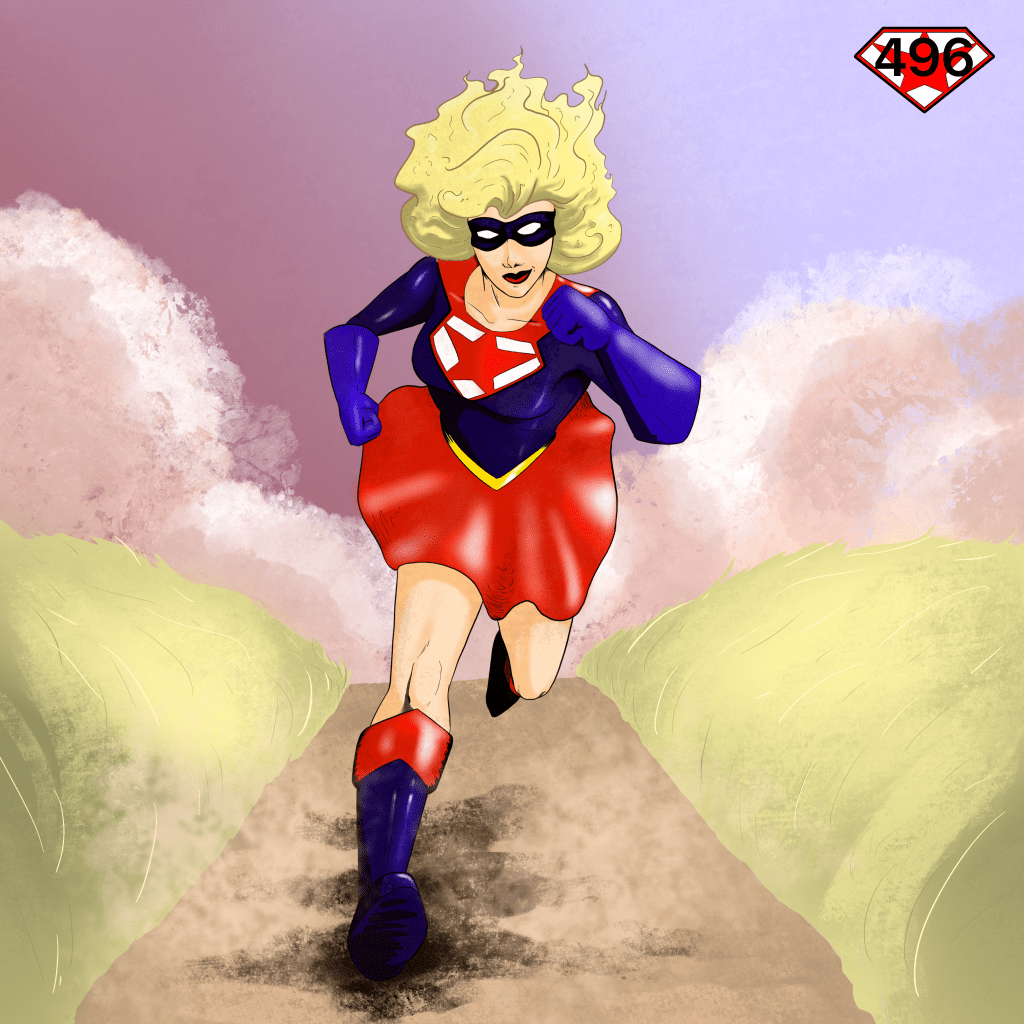
    As mentioned above, the Amalgam universe would take a character from the DC universe and one from the Marvel (sometimes more than 2 characters would merge). There are 2 canonical Amalgam characters that fit the Supergirl role, but I am also going to be putting together 3 of my own amalgamated Supergirls. This time out is one of the canonical ones, American Girl. American Girl is an amalgamation of Supergirl, specifically the Pre-Crisis Kara Zor-El version, and Bucky Barnes. This character only shows up as part of the Amalgam Universe trading cards, specifically the Classic Power Blast series in a card titled Secret Crisis of the Infinity Hour #7. This card, like all cards in this series, is an homage and for Secret Crisis of the Infinity Hour #7, it is an homage to Crisis on Infinite Earths #7. Super Soldier stands in for Superman and the now deceased American Girl stands in for Supergirl. The back of the card mentions that “although American Girl was patterned after his old partner, the two characters had never met before this issue.” This is cleared up a bit more in the Secret Crisis of the Infinity Hour Canvas Cards set, specifically #9, which mentions American Girl was Super Soldier’s successor, as well as naming her Carol Barnes. While I couldn’t find any specific “old partner” in either Super Soldier or Super Soldier: Man of War, this seems to be referencing a Bucky Barnes type. American Girl being Super Soldier’s successor points to the possibility that after Super Soldier’s icy fate after his face off with Ultra-Metallo, perhaps the Super Soldier formula was used on another person, Carol Barnes, granting her similar super-abilities.

    As with all my Supergirl in the Multiverse posts, this is my own artwork. American Girl is taking up the center foreground, running towards the viewer. She is running down a path with fields on either side of it. The top right corner has a motif of American Girl’s symbol with a 496 on top of it.

  • Supergirl in the Multiverse: Earth-496 Super-She-Hulk

    The Amalgam Universe was born from the cross dimensional being known as Access during the pages of Marvel vs. DC back in 1996. This birthed a total of 24 one-shot comics spread across 2 waves that showed stories of characters that were amalgamations of characters from the DC and Marvel universes. The Amalgam universe has several numeric designations such as 1996, 962, 9602, and 496 as well as just being referred to as the Amalgamverse. My coverage of this universe will feature 5 entries for Supergirl in the Multiverse and my initial plan was to use some of these alternative number designations for each. However, to make categorizing them easier I will just be using what seems to be the most likely DC designation of 496.

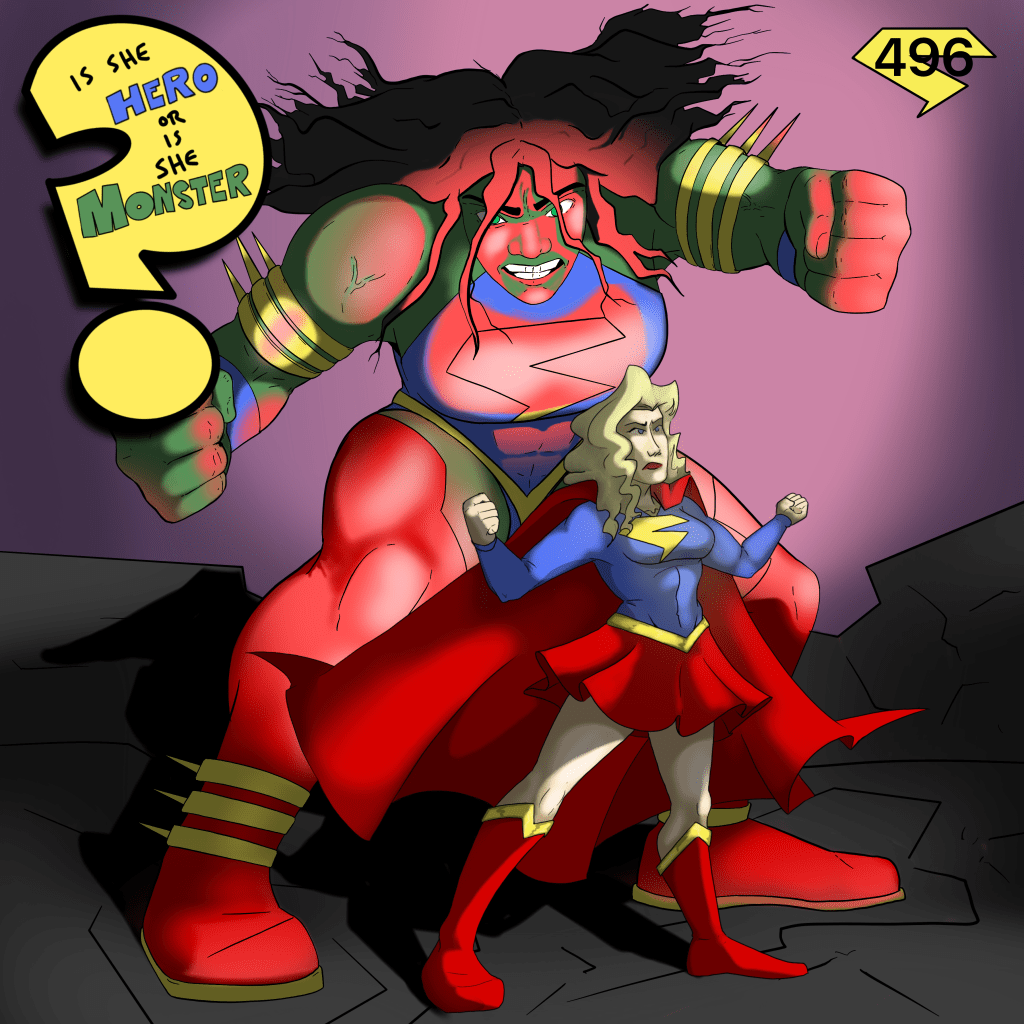
    As mentioned above, the Amalgam universe would take a character from the DC universe and one from the Marvel (sometimes more than 2 characters would merge). There are 2 canonical Amalgam characters that fit the Supergirl role, but I am also going to be putting together 3 of my own amalgamated Supergirls starting with Super-She-Hulk. This is obviously an amalgamation of Jen “She-Hulk” Walters and Supergirl, but I did base this specifically on the protoplasmic shape changing Matrix Supergirl, partly because these 2 characters appear together in a panel in the DC vs. Marvel crossover extravaganza, but also because I had a good idea for the character herself.

    Everyone knows Mae Walters, she is one of the most famous super heroes of the West Coast, Super-Girl, and is often see helping out wherever she can with a friendly face. That is as long as you don’t make her angry, you won’t like her when she’s angry. When angered, Mae looses control of her protoplasmic form and she changes shape into the hulking aggressive monster known only as Super-She-Hulk!

    As with all my Supergirl in the Multiverse posts, this is my own artwork. Super-Girl is shown in the foreground and behind her is her much larger, much angrier, Super-She-Hulk form that is crumbling the ground beneath her. The background has a pink-purple sky. There is a large yellow question mark on the left side of the page with the text “Is she HERO or is she MONSTER”. The top right corner has the symbol of Super-She-Hulk with a 496 on top of it.

  • Supergirl in the Multiverse: Earth-93

    In 1993, after feeling that minority groups were underrepresented in mainstream comics, a group of black creators would set out to to give some much needed love to these minority groups. Milestone Comics, distributed under the wider DC Comics umbrella, would launch in 1993 with a handful of titles including Blood Syndicate, Icon, Hardware, and probably it’s most well know, Static. The imprint would run for a few years before most the comics ended or were canceled and Milestone would instead focus on the Static Shock animated series that had recently launched. The universe mostly focused on the city of Dakota after an event called the Big Bang. The Big Bang was a the result of a massive gang conflict on the Paris Island section of Dakota. The police would interfere with this conflict and would launch tear gas at the gangs. This tear gas was abnormal and laced with chemicals initially meant to be used to later track anyone exposed but would actually have much more drastic effects. Many of those exposed to the gas died, and those who didn’t gained a variety of super human powers. Most of the superpowered characters in Earth-93 got their powers from this quantum juice laced gas, but not all of them.

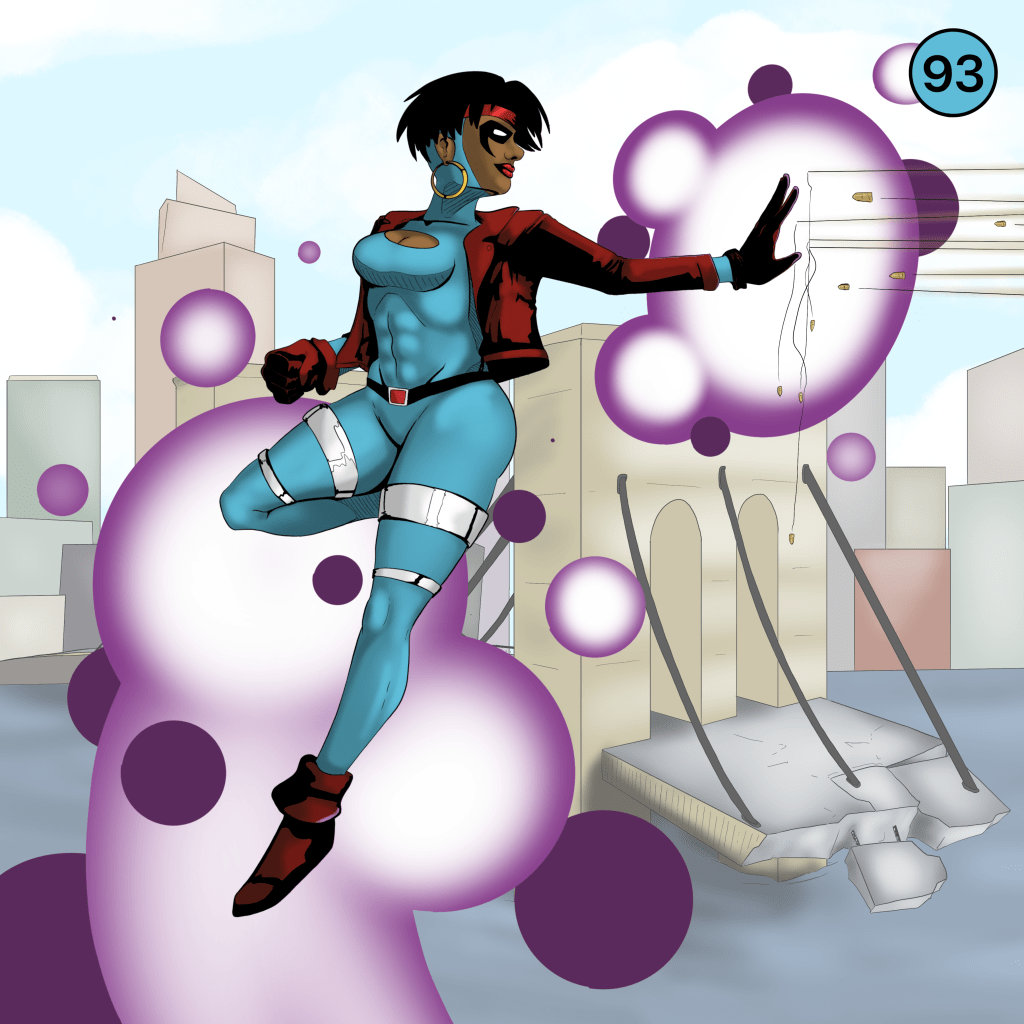
    One of the title characters of the Milestone line was a clear Superman analogue called Icon. Icon too was an alien that escaped certain doom and crashed to earth, but instead of landing on a farm in Kansas, he landed in 1839 on a plantation. He would take the form of a black man and would live for the next century and a half seldom using his powers until meeting a young Raquel Ervin. Raquel, after seeing Augustus Freeman IV fly, came up with the idea that he needed to be a hero, an Icon for the community. She designed a costume for Icon as well as one for a girl sidekick named Rocket. Rocket was of course supposed to be Raquel, and after a few days of thinking it over, Icon and Rocket began their heroic journey. Icon, being an alien, had powers all his own but the 15 year-old Raquel needed a bit of extra gear. Icon gave her a belt that allowed her to store and release kinetic energy which she would use to great effect, mostly blocking attacks and shooting blasts of energy back. While she started only able to leap great distances with the belt, she would later find a way to use the belt to fly properly. Rocket could of course fit as an analogue to a few different characters, her gung ho attitude and figuring out Augustus Freeman’s powers and urging him to become a hero mirrors Tim Drake as Robin, and she seemed to be paired up with Superboy during Worlds Collide, but Icon being so clearly based on Superman does easily place her as the Supergirl of this world.

    As with all my Supergirl in the Multiverse posts, this is my own artwork. Rocket is floating high above Dakota with her kinetic belt. She is also her belt to deflect bullets coming in from the right. The Paris Island section of Dakota as well as the broken bridge leading into Paris Island. The top right corner has a motif of a blue circle with a 93 on top of it.

  • Supergirl in the Multiverse: Earth-72

    Earth-72 is the first of the universes that I’ve covered that is sort of a universe I’ve already explored. If you’ve been keeping up you may remember my Earth-47 entry. As I mentioned in that entry, that universe is also known as Earth-72 and Earth-Prez. Now that we’re taking a look at Earth-72 it gives me a chance to take a look at one of my scrapped ideas from season 1. Earth-72 is pretty strictly relegated to just Prez and his various appearances since his initial series from 1972, and Earth-47 is more of an updated look at the universe that also includes psychadelic and groovy versions of some of the Justice League. Heroes like Sunshine Superman, Speed Freak, and Magic Lantern who form a team called the Love Syndicate of Dreamworld. They all showed up for the first time in Animal Man #23 and while it was more than a cameo appearance, they didn’t do too much and mostly just served to be part of the ensemble to represent the sort of multiverse that existed when DC was trying to not have a multiverse called Hypertime.

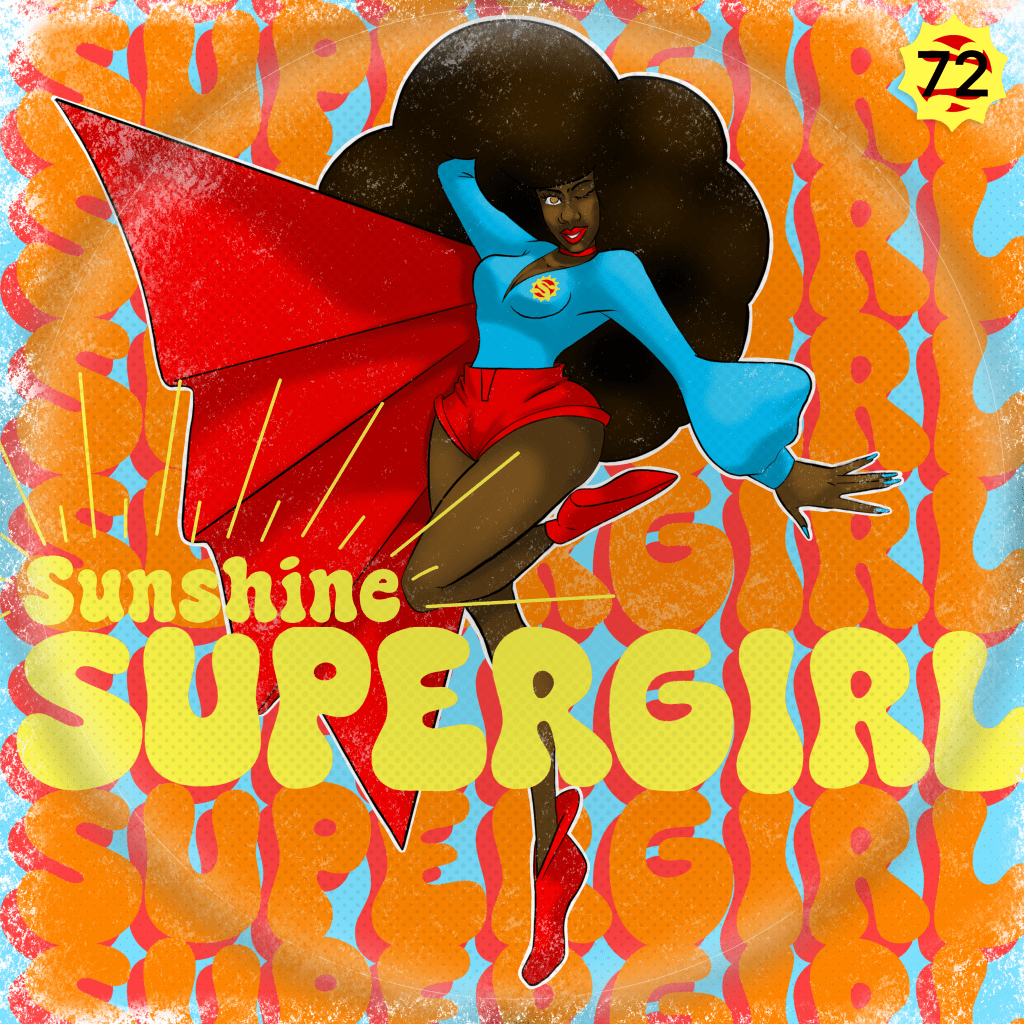
    Earth-72 being strictly the Prez universe probably means Prez Beth Ross should have been the representative for 72, while Sunshine Supergirl should instead represent the more expanded universe of 47 along with the Love Syndicate. That being said, I feel like if there wasn’t the restriction of a number under 51, Earth-47 would’ve been designated as Earth-72 from it’s inception. Part of me wants to believe 47 was picked because it was the last universe with a 7 in it left because it is clearly meant to be a universe with the aesthetics of the 1970s. Sunshine Supergirl is not a canonical character, but as I mentioned above, Sunshine Superman does exist. His full origin, or even his real name, isn’t known but he does seem to have similar powers and abilities to his Earth-0 counterpart so it’s likely his origin is similar and the universe itself is just a bit more funky. A Superman existing always gives the possibility of a Supergirl existing and I have presented just that. Due to the 1970s aesthetic of the universe I have also brought in the most used, and my personal favorite, Supergirl costume featured in comics in the 70s.

    As with all my Supergirl in the Multiverse posts, this is my own artwork. Sunshine Supergirl is striking a pose with her right arm behind her head and her left arm outstretched. Her cape is out to the left. The background is the text “SUPERGIRL” repeated several times, and one of these “SUPERGIRL”s is in front of the hero. The top right has a motif of Sunshine Supergirl’s S symbol with a 72 on top of it. The entire artwork has a distressed look to it to give the look of an old vinyl record sleeve.