A world in the midst of a war, overrun by Nazis and monsters. This world is Earth-24 and the heroes of this universe are The Bombshells. A heroic team formed by Amanda Waller in the late 1930s to help stop the continuing threats brought about by World War II. The Bombshells are all female heroes from many nations and at least 2 alien worlds that first appeared as a DC Direct series of figures in the mid 2010s before launching as a digital first series in 2015.
Supergirl first appeared in the Bombshells universe in digital chapter 3 which would later be included in issue 1 of the print run of the series. Kara Starikov landed in Russia and was raised alongside Kortni Duginovna as sisters. Kara was born on Krypton and has the same powers generally associated with Kryptonians but the Krypton on this universe isn’t show much at all. What we do see is Kara and Kortni as young girls in Russia training alongside the Night Witches before Kara’s powers are revealed in an attempt to save her sister. The Russian government, after seeing this display, enlist the two sisters as Supergirl and Star Girl and use them as propaganda for the Russian military. On a mission, Kara realizes that a supposed Nazi encampment they are set to destroy is actually home to Russian citizens. Kara and Kortni then desert the Night Witches and the Russian government and in the process of fleeing they end up on an American ship and meet Amanda Waller who enlists them into the Bombshells.
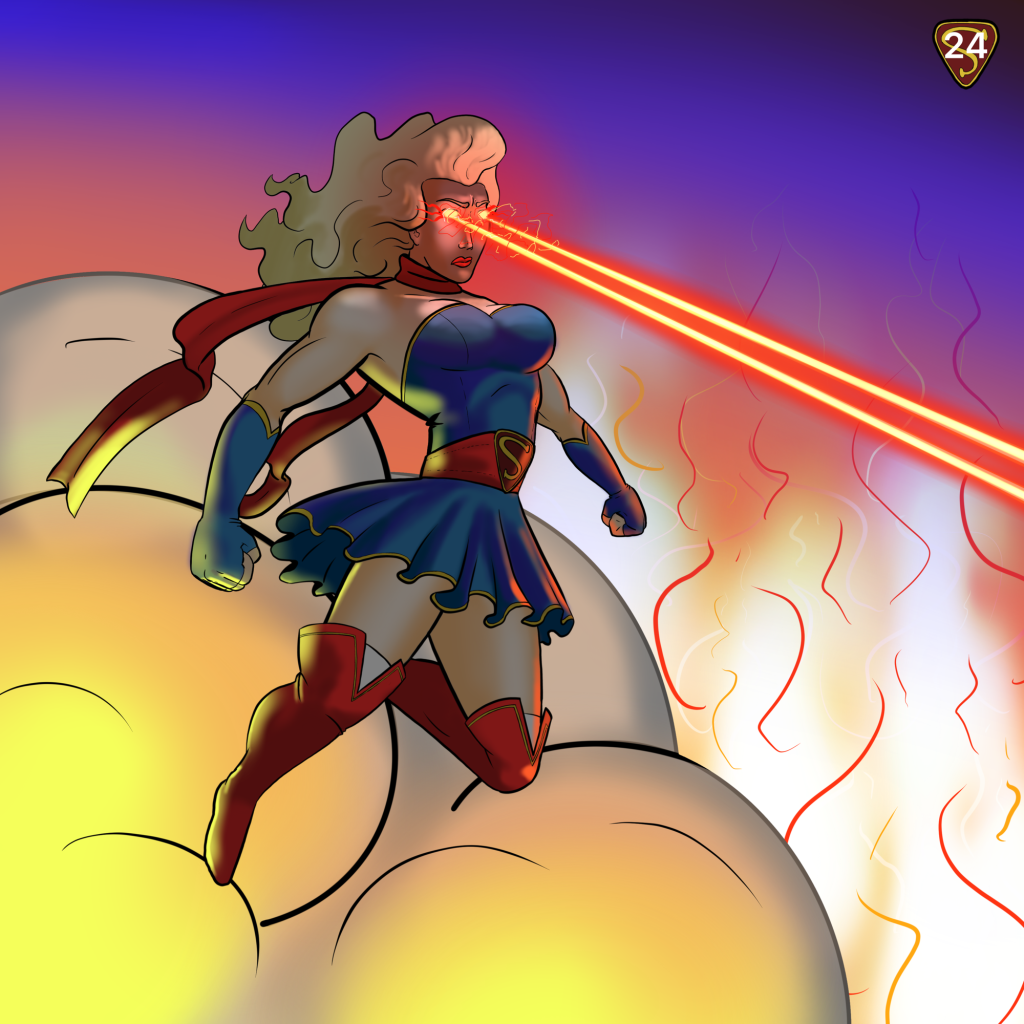
As with all my Supergirl in the Multiverse posts, this is my own artwork. It is a digital drawing that depicts Bombshells Supergirl flying while shooting her heat vision into the lower right of the page. The background is full of explosions and fire. A motif in the top right has Supergirl’s S symbol and a number of ”24”.
DC Pride: Through the Years is an anthology book collecting 3 stories of queer characters from DC’s history; The Flash (vol. 2) #53, Detective Comics #854, and Supergirl (Vol. 7) #19. Alongside these 3 historic stories there is also a brand new Alan Scott Green Lantern story at the end of this 80 page giant. While the whole book is good, for this post I’ll only be focusing on the story featuring Supergirl and Lee Serrano. Supergirl (Vol. 7) #19 was written by Steve Orlando and Vita Ayala with art by Jamal Campbell and lettering done by Carlos M. Mangual. The story is titled “One Life” and while it does have references to some of the larger story arcs Steve Orlando had been building upon, the story is for the most part a standalone. The story puts our main hero in more of a supporting role and instead follows Ben Rubel, a friend of Kara Danvers’ from CatCo, as he is interviewing someone who has become friends with Supergirl.
Lee Serrano is a brand new character introduced in this issue and is based somewhat on co-writer Vita Ayala’s life. Like Vita, Lee is non-binary and uses they/them/their pronouns and is Afro-Puerto Rican. As we learn about Lee’s life throughout this issue we fine out that they’re not out currently but their peers in school already bully them for their looks and how they present themself. One day as Lee is out in National City, the city is attacked and Lee is saved by Supergirl who promises Lee that she’ll be around if they need her. A promise that Lee initially takes as an empty one that any superhero would say to anyone that gets saved. Lee is soon proven wrong as they once again run into the Girl of Steel who not only remembers Lee but remembers to check in on their wellbeing.
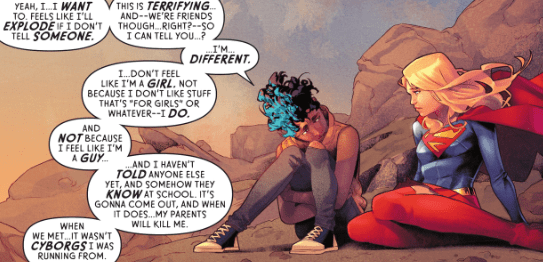
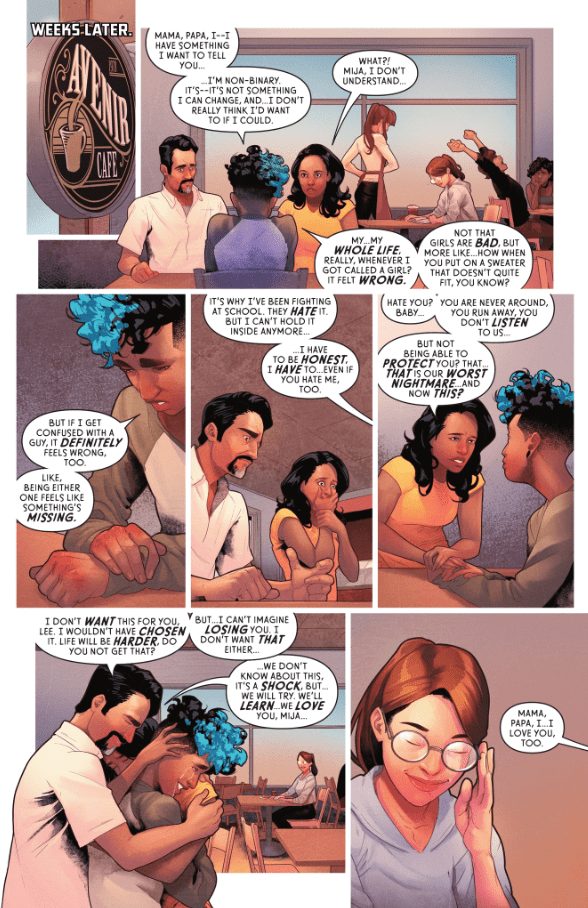
It is at this point when Lee comes out to Supergirl as being non-binary and the pair have a good conversation about parents and how parents don’t always do what their children want. Supergirl discusses her own life and she knows her parents put her in the rocket to earth to save her but she still wishes she had more time on Krypton. She has a particularly good line at this point “Yes, parents can protect you. They can also hurt you deeper than anyone else. Both are rooted in love.” The story continues on as we see Lee suffer more bullying and as they spend more time venting to Supergirl and Supergirl continues to listen and give advice while still being entirely truthful to Lee that things wouldn’t suddenly be okay once they came out. At this point we get some dialogue from Supergirl that ties into the title of the story “You only get this one life, and no one but you should get to decide how to live it.” The scene then shifts to Lee at a coffee shop with their parents a few weeks later.
The scene is told rather naturally and serves both as a coming out story for Lee, as well as really explaining what being non-binary means to readers that may not be familiar with the term. While this scene does have a very happy ending with Lee’s parents saying they will always love their child, it does still feel like a natural coming out story and one that isn’t overly sugar coated. Coming out isn’t this easy for everyone and Lee seems to have particularly supportive parents, but something that seems almost universal is the fear that Lee has going into this as they come out and the text reflects this fear when Lee says “I have to be honest, I have to… Even if you hate me too.” This scene also has a familiar face in the background of the scene (Kara Danvers) that shows Supergirl has continued to keep her promise of being around if Lee needs her.
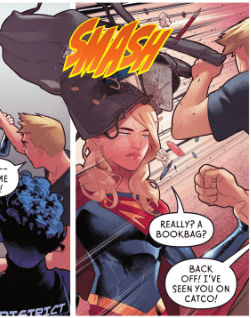
While this could very well be a happy ending to a pleasant coming out story, the story is over just yet. Lee once again encounters their school bully, Chuck, who has Lee cornered. Just before Chuck could take out his anger on Lee for not being heteronormative, Supergirl steps in. Instead of pummeling Chuck and his cronies, she merely takes a backpack to the head and allows Lee to stick up for themself. Lee stands their ground and calls out Chuck for only picking on them because his dad came out as gay and is divorcing his mom. Chuck, now feeling less in the mood for picking on Lee, walks away but not before Lee offers a listening ear just as Supergirl did when they needed it. Chuck, being the pinnacle of masculinity, of course denies that he needs any help as he punches his crony for making a remark about Chuck being gay and walks away.
The story closes out with Ben finalizing his questions for his article about Lee for CatCo and the pair part ways. The story ends as been sees his article “Supergirl: An Indestructible Shoulder” is shown advertised on a large screen out in the city.
As a trans person myself, seeing trans representation, or any queer representation, in a Supergirl story really makes me happy. Steve Orlando and Vita Ayala write a compelling and believable story that has a happy end while also showing Lee go through real struggles. Coming out isn’t always as easy as it was shown with Lee coming out to their parents but it shared a lot of similarities to when I came out to my parents so it can happen. Also sometimes it’s nice to read a story about queer people where they can have happy endings. I will say that Chuck being a bully to Lee because his dad is gay feels a little tropey and, to me, felt a bit on the nose. I do like seeing the parallels of Supergirl being there for Lee and then Lee being there for Chuck and how differently each character approached that. The story also does a great job of bringing Lee’s struggles up to the level of Supergirl’s struggles and showing that, while mundane, Lee’s problems in life are just as important and scary as when Supergirl has to fight space robots. All in all, this is a wonderful story with fantastic art by Jamal Campbell that is really worth reading and should be fairly easy to get a hold of. The issue is available on the DC Universe app, and aside from it’s initial print release, it has also been collected in Supergirl: Plain Sight that collected issues 15-20 of the series. The story was also bundled in the DC Pride: Through the Years as I mentioned at the start of this post.
Thanks for reading! If you made it this far and have any other thoughts, comments, or suggestions feel free to email me at blogofsupergirl.com!
Earth-23 is most well known for it’s iteration of Superman. Calvin Ellis first appeared in the last issue of Final Crisis from 2009. Calvin, when he isn’t Superman, is the black president of the United States on Earth-23. The Superman of Earth-23 has continued to show up fairly often and he is currently part of the multiverse spanning team of Justice Incarnate.
While there isn’t a Supergirl of this universe at this time, Kelel’s (Calvin’s Kryptonian name) Krypton seems to share similarities to the Earth-0 counterpart. Because of these similarities, there is a possibility for the introduction of a Supergirl which may have similar origins to the Earth-0 version. Based on the altered Kryptonian naming schemes, Karel seems to be a good choice for this Supergirl and I have the thought of her crashing to earth on the White House lawn. This could present an interesting story for President Ellis to deal with and would be a good way to have Supergirl interact with both of his identities.
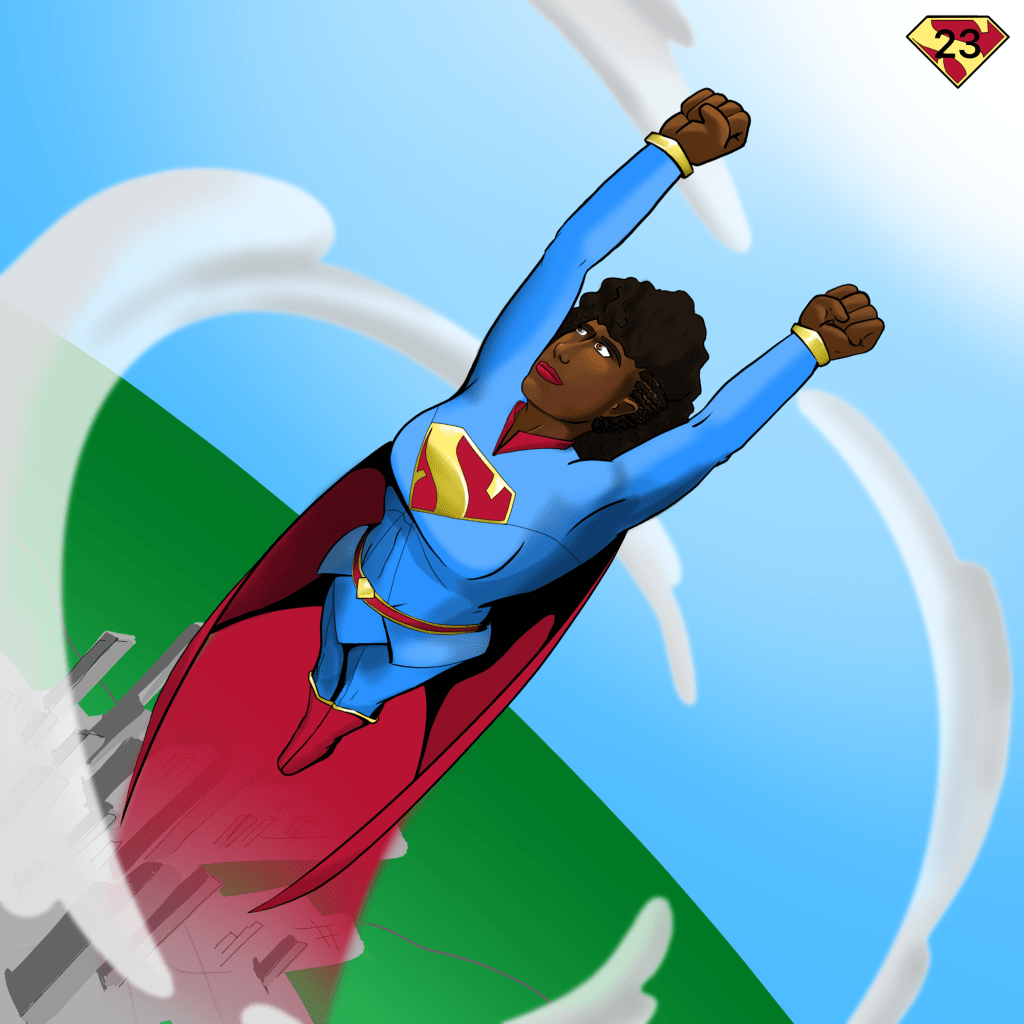
As with all my Supergirl in the Multiverse posts, this is my own artwork. A digital drawing that shows the Supergirl of Earth-23 flying up towards the camera with her arms outstretched. Clouds form in circles around her and a city is show far below. The top right corner has a motif of Supergirl’s S Shield with a 23 on top of it.
Picking up right from where we left off with just a Crisis and a major status quo for the girl of steel happening since the last issue we covered, we now jump headfirst into the deep end of the Matrix Supergirl as she headlines her own title, but even by issue 2 of this mini series she’s not alone.
Supergirl (Vol. 3) #2 was part of a mini-series from 1994 that was released after the Death of Superman which made it cool and profitable to be a fan of the big S. Although the cover is full of Supergirl clones, the story barely features them. The story instead follows Supergirl as she visits Singapore and undergoes tests through the LexCorp facility stationed there. Here LexCorp, along with the reader, learns more about the upper limits of Supergirl’s powers especially in regards to her shapeshifting ability. While this is happening, Supergirl also meets Elizabeth Perske, a former wife of the first Lex Luthor, who tries to warn Supergirl about her new boyfriend Lex Luthor II. This drop of suspicion leads our hero to begin snooping in on various LexCorp employees where she learns they don’t think too fondly of her and view her merely as Luthor’s lapdog who will do whatever he says. The issue ends with Dr. Eller, who has been in charge of Supergirl’s testing, on the phone with Dr. Happersen, one of Lex Luthor’s main confidants. Happersen is shown in a room full of Supergirl Clones which he is calling “Operation: Protomatter” and urges Eller to keep Supergirl in Singapore, a task that Eller proclaims is just too easy when dealing with Lex’s Bimbo. Supergirl, in her snooping era, overhears Eller’s end of the conversation and the issue ends with Supergirl demanding to know everything Eller knows about “Operation: Protomatter”.
Moving forward again to Supergirl (Vol. 4) #30, from 1999, we are met with a rather menacing cover that features both Supergirl holding a skull, and also a shadowy Supergirl shaped figure sneaking up on her. When I was compiling this list I made a deliberate effort to not include Supergirl vs. Power Girl or Supergirl vs. Bizarro-Girl covers because those are also surprisingly frequent and as such fall into a different category than what I want to look at with these covers. With that being said, the backwards S on the shadowy Supergirl does have a bit of Bizarro in her look but she’s arguably more Supergirl than the protagonist. As I get into the story I’ll mostly gloss over the Cutter storyline since it doesn’t relate too much to the topic. Supergirl, returning to Leesburg from being out of town, is met with a city faced with a serial killer that has been dubbed the “Piranha”. Fred Danvers is caught in the clutches of this Piranha and finds out it’s none other than Matrix? Matrix is of course the protomatter Supergirl we mentioned in the last issue we discussed and the Supergirl that merged with Fred’s Daughter just 29 issues ago in this same title. So how are Matrix and Supergirl both walking around in Leesburg? The answer to this is of course because when Matrix merged with Linda not all of the protomatter was used and some got washed away into the sewers eventually reforming and growing sentience. After a brief tussle that involves a bit of introspection about which of them is the real Supergirl and if taking over Linda’s body was the morally right thing to do or a selfish conquest, Matrix seems to overtake Linda (Supergirl) Danvers. The issue is left on a cliff hanger where we see Matrix atop Fred Danvers’ car holding Supergirl’s costume in her hands as she screams “There’s just Matrix now! MAAAATRIIIIX!!!!”
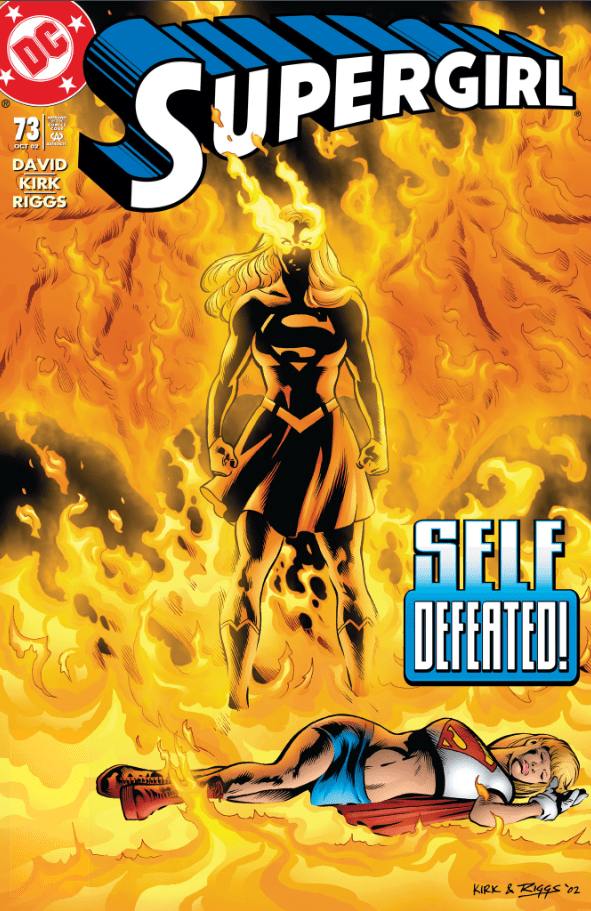
Issue 73 of this same title, from a few years later in 2002, is quite similar to the last book discussed, issue 30. Here we are once again seeing our titular hero go against another possibly more true Supergirl, however the script has been flipped somewhat. Before we had Linda Danvers that had partially merged with the protomatter that was Supergirl, fighting the remainder of the protomatter. In this issue however Linda, now separated from the protomatter entirely, is facing against the Supergirl that is the earthborn angel. This is what she believes she is fighting at least. The story involves Linda, Buzz (the Demon), and Mary Marvel traveling to the point on earth where the Garden of Eden originally stood. Once they arrive a Supergirl with fiery wings attacks Linda and a battle ensues. It is however revealed that it is Bizarro Supergirl, with the help of the Demon Mother, controlling the earthborn angel. This does seem to go a bit against my rules of not including Bizarro Supergirl stories in this list but I think since there are 2 separate Supergirls shown in the story it should count on a technicality at the very least.
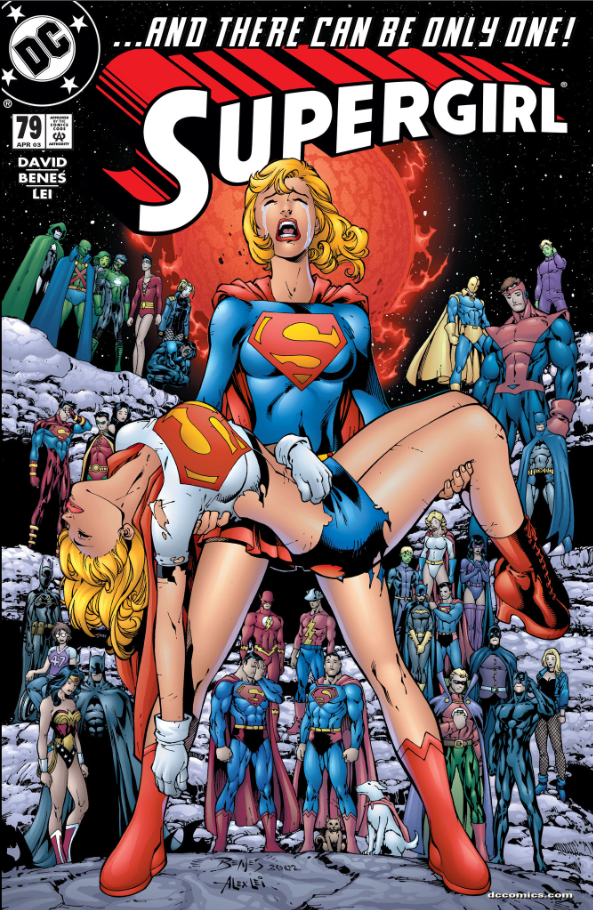
Another thing i tried to avoid doing while compiling this list was limiting storylines to a single issue to look at. In last week’s post we looked at issue 11 of The Daring New Adventures of Supergirl. That storyline also went into issue 12 of the title but I only included the first cover. So why is this different? Part of it is because of how far reaching this story, Many Happy Returns, is and part of it is because the difference in what’s happening in these 2 issues is such a major change, and part of it is because both of these are homage covers and I wanted to talk about that. Homage covers are going to become quite frequent in the remaining books as we close out this list and these 2 are homages to some of the most important moments in Kara Zor-El’s life; her arrival on earth, and her death. Supergirl (Vol. 4) #75 is an homage to Action Comics #252, the story of Supergirl first arriving on earth after being rocketed away from Argo. This issue tells a similar story, but instead of her rocket arriving on the pre-crisis earth as it should’ve, she instead lands on the post-crisis earth and meets a much different Supergirl. Their fight in this issue is quite brief and mostly boils down to a misunderstanding between the 2 gals of steel. Issue #79 is an homage to Crisis on Infinite Earths #7, part of the historic maxi-series and the issue where Supergirl meets her ultimate fate at the hands of the Anti-Monitor. The issue we’re discussing doesn’t actually feature any interaction between the 2 Supergirls and instead mostly showcases Linda’s life as she trades places and goes to where Kara should have gone. The story shows that Linda leads quite a full life on this earth that is sort of based on pre-crisis earth-1 but also has quite a few earth-2 characters. She becomes a hero to the world, has many adventures with Superman, eventually reveals to Superman she’s not who she says, and then marries him and has a daughter which then brings this issue up to 3 Supergirls. The issue ends with the Spectre telling Linda she has to go back to her own earth so that history can right itself with either Supergirl in their own universe fulfilling their own destinies.
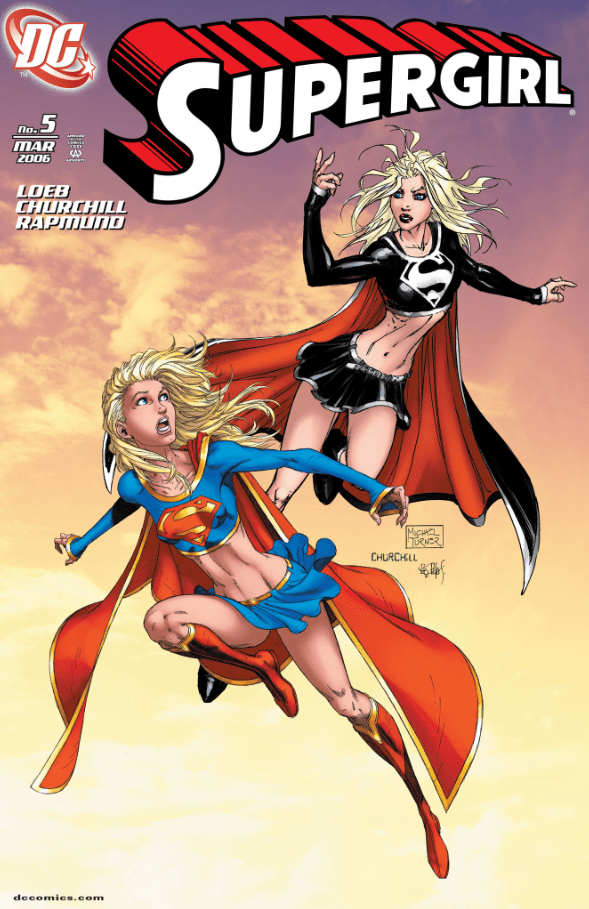
Kara Zor-El returned to the main DC universe and got a new ongoing title in 2005 and very early on in issue 5 we get a new entry in the Supergirl vs Supergirl category. Supergirl (Vol. 5) #5 from 2006 has a cover with 2 Supergirls. One in the classic red and blue while the other has a predominantly black outfit. The issue shows a rather aggressive and brutal fight between the 2 Supergirls that takes up the majority of the issue. Through dialogue we get a better look at this Kara Zor-El’s origin that includes her father sending her to earth after Kal-El in order to kill him. Because this origin is told to us by the “evil” Supergirl its unclear whether or not what she said is true. The fight between them also briefly features a standoff with the Justice League before the duo of steel crash lands in Gotham Harbor. There is a brief bit of stalling from Batman before Superman and Wonder Woman enter the scene and the fight is finally decided after Wonder Woman lassos them both. After being compelled by the Lasso of Truth to reveal the true Kara Zor-El, the pair merges together. Kara explains that she doesn’t care what happened to her before she landed on earth, and what’s important is what she wants to do now and that is to be a hero.
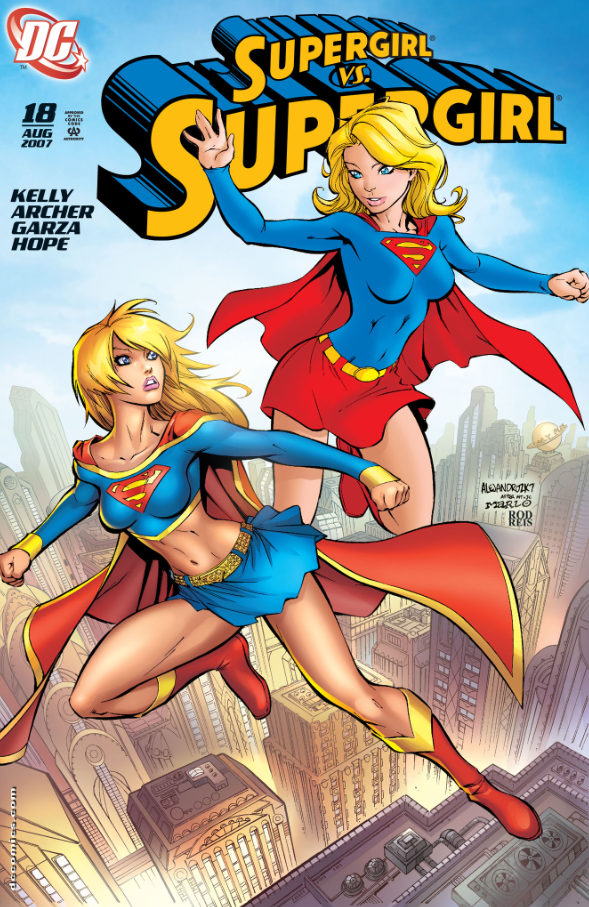
Coming in just a year later we get a new Supergirl vs Supergirl story in issue #18 of the title. If this cover looks familiar, that’s because its a clear homage to the one we looked at before, issue #5. While the cover matches issue 5, the story also has some similarities to the Many Happy Returns storyline we discussed before that. In this issue Supergirl is having halucinations and struggling to fight the urges inside her to kill Superman. All while this is happening we’re introduced to a very happy-go-lucky Supergirl that once again seems to resemble the pre-crisis version. After a bit of fighting and the “perfect” Supergirl trying to convince Kara that she’s not the real Supergirl, our hero overcomes and it’s revealed that everything she’s been through has been the result of Dark Angel. Dark Angel had been sent by the Monitors to track down potential anomalies in the new post Infinite Crisis world and test them to see if they’re really supposed to be in this universe or not. Our hero does pass the test and a Monitor tells her that the information she’s come to know about her life on Krypton and what she knew of Zor-El was all fake and she wasn’t actually sent to earth to kill her cousin.
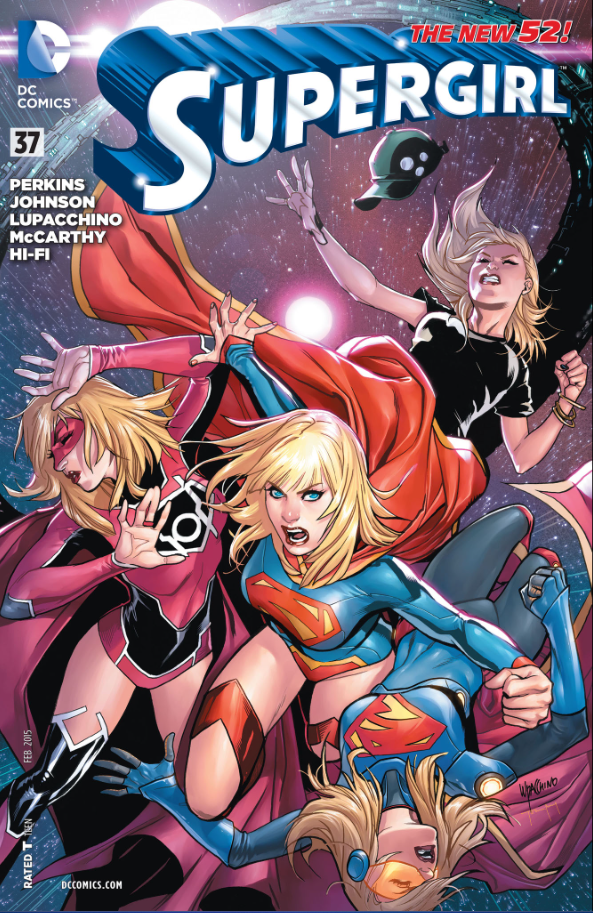
Supergirl (Vol. 6) #37 from 2015 is the next entry on our list and shows Supergirl fighting not one but three copies of herself in various familiar costumes. The story itself features very little Supergirl on Supergirl action and mostly explores the ongoing narrative of Kara in space school at Crucible. Crucible is a school for various young heroes from planets all over the galaxy to train and learn how to be better protectors of their home worlds. The issue follows Kara and her classmates – Maxima, Tsavo, and Comet – as they go through various lessons and tests in this space school. About halfway through the book we see the scene from the cover while Kara and Comet are doing an exercise somewhat like capture the flag. Supergirl seems to be easily overtaking Comet in the challenge when she’s suddenly swarmed by duplicates of herself. These duplicates are revealed to just be projections made by Comet to overpower Kara and allow him to win the challenge.
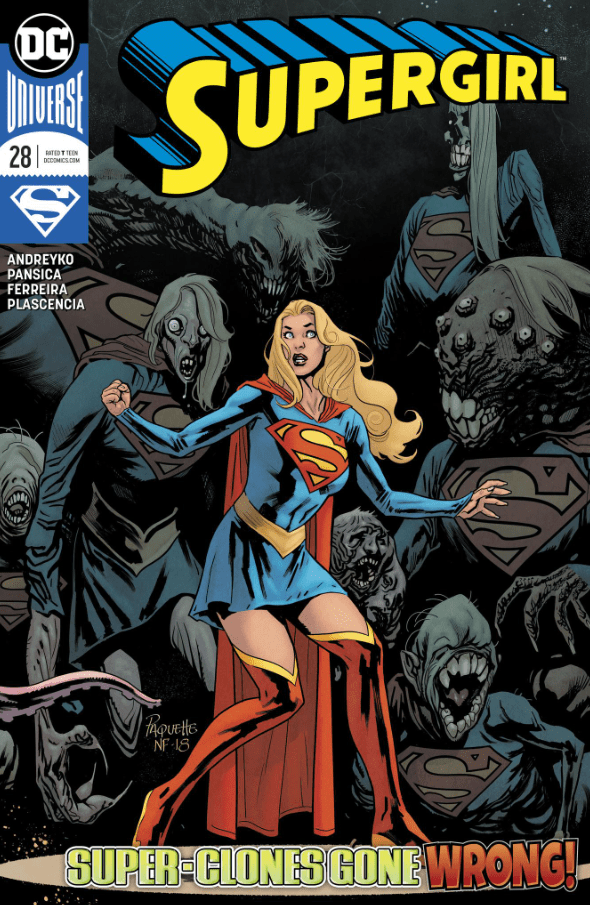
We now get to the last book in our list, Supergirl (Vol. 7) #28 from 2019. This issue opens with Supergirl, along with the Omega Men, fighting a horde of imperfect cones of herself. Seemingly overpowered, Supergirl asks Ryand’r, a Tamaranean, to give her a solar boost which allows her to preform a clap resulting in a stunning concussive blast. While only meaning to stun these monstrous clones, they instead perish due to the unstable nature of the cloning process done by Harry Hokum. After confronting Harry Hokum, Kara finds a new clue in her search for more clarification of the destruction of Krypton as Hokum points her towards The Circle before quickly teleporting away.
And with that we have completed looking at a bunch of comics that all feature Supergirl fighting herself in one way or another. As we left off last week we had 2 imposter stories, 1 alternate universe story, and 1 clone story. Surprisingly, we don’t have any more imposter stories to add to the list but we do have a new category in the form of split personalities which we saw in Supergirl (Vol. 4) issues 30 and 73 and Supergirl (Vol. 5) issue 5 giving us a total of 3 for that category. Vol. 4 issues 75 and 79 along with Vol. 5’s issue 18 gives us 3 more to add to the alternate universe category, since all 3 of those issues feature a pseudo pre-Crisis Supergirl which brings that total up to 4. and to close out our list we add Supergirl (Vol. 3) #2 and Supergirl (Vol. 7) #28 to the clone category leaving it with a total of 3. I’m unsure where exactly to categorize Supergirl (Vol. 6) #37 since it’s revealed to be just a projection but it seems most like the new split personality category so that can be bumped up to a total of 4.
Supergirl (vol. 8) #2 has come out now and it is unfortunately not Ellie Leeds in the role of the fake Supergirl, and is in fact Lesla-Lar. The direction of the story does seem very interesting and I’m excited to see how Sophie Campbell handles Lesla-Lar because she is one of my favorite Supergirl villains and she hasn’t seen much of the spotlight so far. As a whole I think the Supergirl vs Supergirl trope was a lot of fun to look at and explore and I think Supergirl is a great character to look at fighting herself. Supergirl has had a lot of identity issues trying to adjust to life as a human when she spent so much time on Krypton or the Matrix having trouble viewing herself as more than just a science experiment. So these broader ideas really help open the character up to fighting a physical manifestation of herself while also allowing introspection about who the real Supergirl is.
I hope you enjoyed reading this extensive look at Supergirl vs Supergirl and I hope you stick around for many more posts about the girl of steel. If you have and thought or suggestions feel free to email me at blogofsupergirl@gmail.com.
Kingdom Come is a fantastic story created by Mark Waid and Alex Ross and is the predominant storyline for the universe designated as Earth-22. Originally, as a Hypertime reality, the universe was designated instead as Earth-96. The universe as a whole features a dark future with heroes and villains fighting in the streets and a disregard for human life. Thanks to the sacrifice of Captain Marvel, this dark age of heroes was able to come to a close and allow for a new age of young heroes to step up and lead to a better future.
This is not a post about the universe as a whole, but about a single character; Supergirl. Supergirl of Earth-22 doesn’t show up frequently or in any major depth but she is present in Kingdom Come #1 and has shown up in cameos in the continuing stories set in this universe. This universe presents a Supergirl that has left the 20th century behind and made her home among the Legion of Super-Heroes in the 30th century. In the 30th century she has settled down with Brainiac 5 and had a daughter aptly named Brainiac’s Daughter. The rest of Kara’s life in this universe isn’t shown but the rest of this universe having so many nods to pre-crisis DC it is likely that this Supergirl’s origin matches those of the pre-crisis Supergirl who also had quite a few stories with the Legion.
As with all the Supergirl in the Multiverse drawings on this site, this is my own artwork. This digital drawing depicts the Supergirl of Earth-22 hovering down towards the camera with her cape and hair flowing behind her. On her left hand is a wedding ring with a small detail of the Brainiac symbol to represent her marriage to Brainiac 5. The background shows the 30th century Metropolis with the Legion of Super-Heroes headquarters shown prominently. A motif of Supergirl’s symbol is in the top right with a 22 on top of it.








 The Daring New Blog of Supergirl